The title of today's post comes from a Ben Folds Five song (entitled, funnily enough, Battle Of Who Could Care Less), mostly because it happens to be playing in my study at this exact moment, but it's also quite apt. I hate doing it, but I feel a rant coming on...
As an unemployed museums person on the bottom end of the museums ladder, I spend a lot of time scouring the internet for job adverts. And a trend is beginning to attract my attention: I have seen in the last year (last few months particularly) a lot of traineeships and internships aimed at getting young people into enty-level positions which would otherwise be denied to them due to lack of education/experience. Which is great - the museums sector desperately needs a crop of young people with experience, and outside of volunteering there are few ways to get the necessary experience. But what I'm not seeing advertised anywhere are the entry-level positions that these trainees/interns are supposed to be going into after they're done being trainees and interns. If there were any, I'd be applying for them myself!
Maybe next year there will a spate of entry-level positions advertised to accomodate these fresh, newly-trained museums professionals. But I doubt it. The museum sector as a whole was hit early and hard by the governments cuts made in the wake of the recent (and ongoing) financial crisis, and continue to be made. Where people leave or retire from a post, they are not generally renewed or readvertised, and new positions are very rarely being made. Especially, it seems, in the sciences. This may just be my bias because I pay more attention to what's going on the the world of science, but I'm not convinced. While science curatorships are cut, positions in the arts are still being advertised. Which doesn't surprise me, because while the general public is not as interested in art (see my post from a while ago discussing the results of a Museums Association survey on this topic), it is the art supporters that bring in the most money to museums.
So where does this leave our current trainees and interns? Sadly, I suspect it will leave them in the same position as me in a year or two - unemployed and bitter at the injustice of the world, with no use for their new-found knowledge and skills except to volunteer at their local museum, which will probably by then be run by an army of volunteers as the paid staff find themselves victims of yet more cut-backs. Ah, the Big Society at work.
Hey-ho. Actually, this week I've found a few jobs to apply for (some of which I'm actually qualified for!), and I've just applied for a job in the States, where the global financial fucktastrophe doesn't seem to have hit museums quite so hard. Fingers crossed!
Thursday, 24 February 2011


Monday, 7 February 2011
Rabbits, Revulsion, & Repetition
There is always a certain element of worry involved when running a public event using handling objects. First, obviously, that the precious museum objects will be damaged, but there is also a concern over how people will react to them. Especially when using dead animals. Some people can find stuffed animals quite upsetting, and there is always a percentage of the audience that is just repulsed by wet-preserved specimens. But I have usually found that, the more worrisome we think a specimen is, the cooler children think it is. A good example would be the freeze-dried week-old baby rabbit that we (when I say "we" I mostly mean the biology curator. I'm just a volunteer!) used in a museum event in Bristol yesterday to celebrate the Chinese New Year (it's the Year of the Rabbit, in case you hadn't heard!). It is a cute little blighter, all curled up with its eyes closed almost as if it could be sleeping, but I'll admit there was a little curatorial worry that it might be a step too far. We were using a couple of stuffed adult rabbits, but dead baby animals are always a more tragic sight, and we debated whether we should actually have the kit on display. We needn't have worried at all: some adults found it mildly disturbing, but most children wanted to cuddle it and take it home! They were picking it up without a second thought, often to slightly queasy expressions from their parents, even after being told that it was a real dead rabbit. Their curiosity, and innate attraction to all things cute and fluffy, outweighed any worries they had about touching a dead thing. And of course the younger ones just thought it was sleeping. Aren't children wonderful?
The event seemed to be a huge success, judging by the number of people there, and now there are dozens (possibly even hundreds!) of Bristolian children who should be able to tell the difference between a rabbit and a hare (hares are larger, with longer ears, live solitarily above ground, and produce precocial (well-developed at birth) young rather than altricial (blind, naked and ugly!) young like rabbits), and between a rabbit and a rodent (lagomorphs (rabbits and hares) have 2 extra dinky teeth behind the top incisors, which rodents lack (anyone know why they have them? Wikipedia wasn't able to tell me that!)). I lost count of the amount of times I recited those nuggets of information to people, but that is the nature of public events: there is always an inevitable amount of repetition involved, because people want to know the important things. It did mean that my more interesting rabbit facts (well, I thought they were interesting!), such as that rabbits can only breathe though their nose and are incapable of vomiting, went unused, but you can't have everything I suppose!
The event seemed to be a huge success, judging by the number of people there, and now there are dozens (possibly even hundreds!) of Bristolian children who should be able to tell the difference between a rabbit and a hare (hares are larger, with longer ears, live solitarily above ground, and produce precocial (well-developed at birth) young rather than altricial (blind, naked and ugly!) young like rabbits), and between a rabbit and a rodent (lagomorphs (rabbits and hares) have 2 extra dinky teeth behind the top incisors, which rodents lack (anyone know why they have them? Wikipedia wasn't able to tell me that!)). I lost count of the amount of times I recited those nuggets of information to people, but that is the nature of public events: there is always an inevitable amount of repetition involved, because people want to know the important things. It did mean that my more interesting rabbit facts (well, I thought they were interesting!), such as that rabbits can only breathe though their nose and are incapable of vomiting, went unused, but you can't have everything I suppose!
Saturday, 8 January 2011
Goodbye old Scotland, all covered in snow...
You may have noticed that I've not posted in a while, and that's because I've been too busy couch-surfing these last few weeks! My contract in Glasgow finished at the end of November, and I've since moved back down to sunny Somerset while I hunt for another job. But I thought I should write one last post about Glasgow, to try and sum up my wonderful museum experiences there...
I was thinking earlier about how much I've learned in the last few years, and this last year especially, about working in museums, and how far I've come since I first interviewed for a museum job 3 years ago (and embarassed myself horribly, I'm ashamed to admit - at that point I was in no way qualified for the job at hand!). I first started volunteering at my local museum because I didn't know what else to do with degrees in Zoology and Palaeobiology...I had to some extent educated myself into unemployability. Except in the fields I wanted to be in of course, because I lacked a PhD. So I started helping out at the museum for something to pass the time. And quickly fell in love with the place. It's a little hard to explain sometimes why I love what I do...I guess it always is with these things: if the person you're talking to doesn't share your interest, then it's hard for them to understand it. But I enjoy cataloguing and photographing and cleaning specimens, and knowing that with any luck my care will mean that the specimens will survive, complete with useful information, for many years, to be studied and cared for by future generations of nerdy museum people. And I love learning about the specimens. Just through documenting the mammal collections in my former museum I learned a huge amount about them, and their history, because I had to cross-reference old catalogue records, and perform endless internet and book searches to identify species that had been labelled wrongly or had been accessioned under old defunct names. And I love the physicality of the work, and the fact that there are so many different things to do - in one day I could be painting a specimen's stand, then cleaning a skeleton, feeding the live animals, putting some bird nests in the freezer and processing the ones that have come out, pinning insects...it would leave me exhausted at the end of a day, but immensely satisfied!
And from my wonderful experiences over the last few years, through volunteering and working with some lovely, patient, instructive curators, I think I have become a competent natural history curator myself. There is still a lot I can learn about collections care and conservation, and I can't wait to learn it, but I am no longer the terrified, unconfident girl who ummed and ahhhed her way through that interview 3 years ago. And hopefully I'll find a new position soon, because I can't imagine giving up on this career that I love and going back to a normal job. That would be far too boring!
I was thinking earlier about how much I've learned in the last few years, and this last year especially, about working in museums, and how far I've come since I first interviewed for a museum job 3 years ago (and embarassed myself horribly, I'm ashamed to admit - at that point I was in no way qualified for the job at hand!). I first started volunteering at my local museum because I didn't know what else to do with degrees in Zoology and Palaeobiology...I had to some extent educated myself into unemployability. Except in the fields I wanted to be in of course, because I lacked a PhD. So I started helping out at the museum for something to pass the time. And quickly fell in love with the place. It's a little hard to explain sometimes why I love what I do...I guess it always is with these things: if the person you're talking to doesn't share your interest, then it's hard for them to understand it. But I enjoy cataloguing and photographing and cleaning specimens, and knowing that with any luck my care will mean that the specimens will survive, complete with useful information, for many years, to be studied and cared for by future generations of nerdy museum people. And I love learning about the specimens. Just through documenting the mammal collections in my former museum I learned a huge amount about them, and their history, because I had to cross-reference old catalogue records, and perform endless internet and book searches to identify species that had been labelled wrongly or had been accessioned under old defunct names. And I love the physicality of the work, and the fact that there are so many different things to do - in one day I could be painting a specimen's stand, then cleaning a skeleton, feeding the live animals, putting some bird nests in the freezer and processing the ones that have come out, pinning insects...it would leave me exhausted at the end of a day, but immensely satisfied!
And from my wonderful experiences over the last few years, through volunteering and working with some lovely, patient, instructive curators, I think I have become a competent natural history curator myself. There is still a lot I can learn about collections care and conservation, and I can't wait to learn it, but I am no longer the terrified, unconfident girl who ummed and ahhhed her way through that interview 3 years ago. And hopefully I'll find a new position soon, because I can't imagine giving up on this career that I love and going back to a normal job. That would be far too boring!
Thursday, 7 October 2010
Gideon Mantell: Pioneer of Palaentology
Since the blog's been a bit quiet lately, and I have little that is new and interesting to write about at the moment, here is a lazy post consisting of a transcript (with some minor editing and additions, and obviously much of the show-and-tell aspect removed!) of the talk I gave at the museum a few months ago about Gideon Mantell. Enjoy!
----------------------------------------------------------------------------------------------------------------------------------

----------------------------------------------------------------------------------------------------------------------------------
Gideon Algernon Mantell was a county doctor with a practice in his hometown of Lewes, Sussex, where he was born in 1790. He was an excellent surgeon and midwife...at a time when up to 1 in 30 women died in childbirth in hospitals, Mantell lost only 2 patients in over 2000 births.
He was also passionate about the infant science of geology, having collected rocks and fossils from local quarries since he was a boy. At this time geology really was a very new science: it was only in 1654 that Archbishop Ussher used the chronology of the bible to date the creation of the world to the night before 23rd Oct 4004BC, and this was for at least the next hundred years the prevailing view. It was only in the late 18th/early 19th century that people really began studying the rock strata, and realising that they must have taken much more than 6000 years to form (although they had no way of dating the rocks at all, since carbon dating wouldn’t be discovered for a couple of hundred years!).
Mantell acquired a huge fossil collection, largely relying on local quarrymen, who he paid to provide him with material. But after the publication of his first book on the Geology of Sussex word started to get around of the fabulous bones to be found in the Tilgate Forest quarries, and he suddenly had competition for specimens. He was much vexed when a local amateur collector began outbidding him for fossils, writing in his journal, “…Drove to Cuckfield, and endeavoured to obtain some fossils from the quarrymen who have been employed by me so many years; but the ungrateful scoundrels refused to let me have one, having found a customer on the spot…It is after all a very cruel affair: when there are thousands of quarries in England which would be equally productive and interesting if persons would but take the trouble to explore them, I must be robbed of the fruits of my industry and trouble!...”.
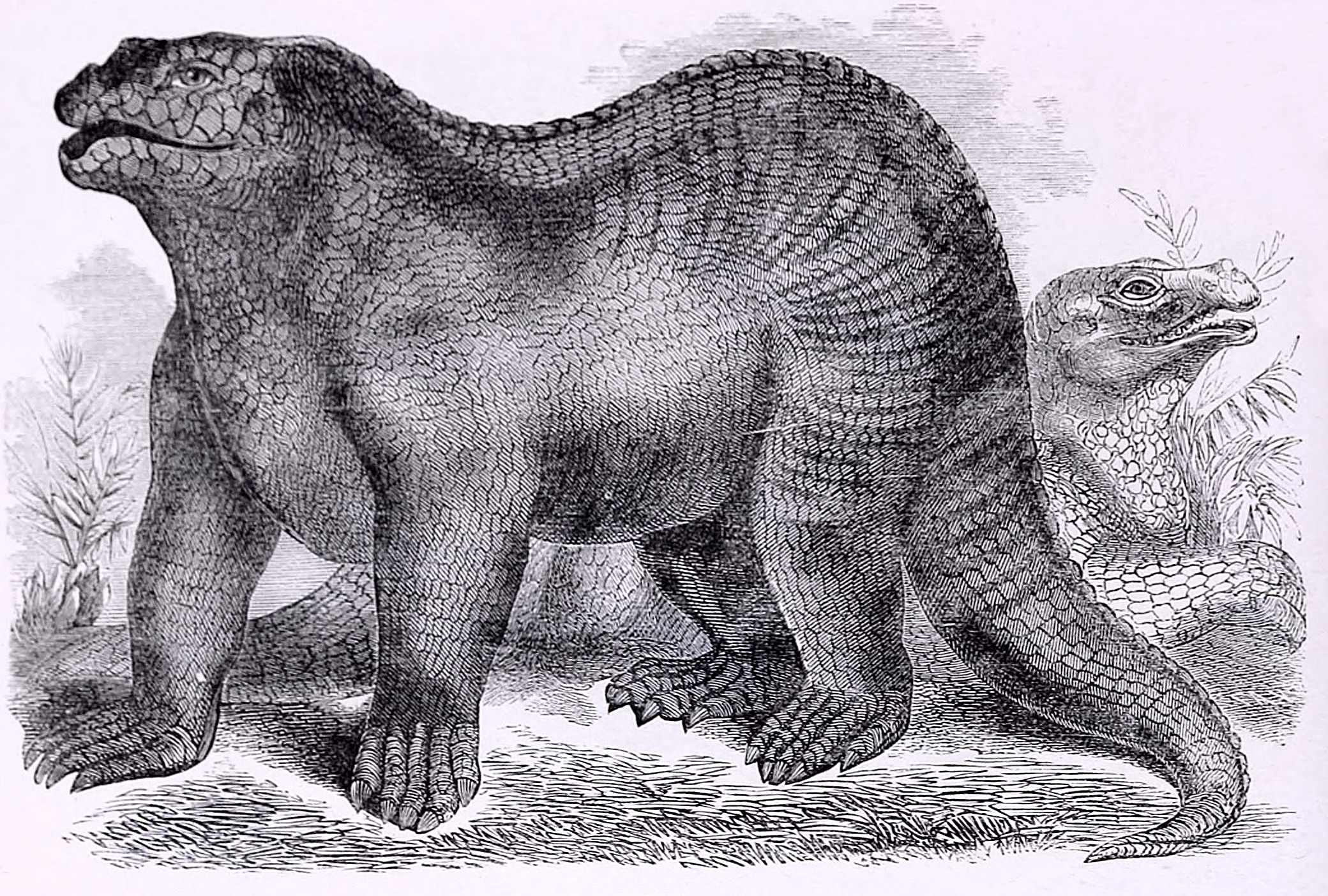
For many years Mantell was a successful doctor but a struggling amateur geologist; even after the publication of his first book he still struggled to gain recognition from the big names in the field. But amongst his collection he had pieces of bone from impossibly large extinct creatures, which he correctly recognised as reptiles. He took a tooth of one of these creatures to the Hunterian Museum at the Royal College of Surgeons in London. The curator there showed him an iguana that had recently been brought back from the West Indies, and Mantell was impressed with how similar in form the teeth were. The creature was named Iguanodon (meaning ‘iguana tooth’). As it happens, the comparison with iguanas was rather oversold, as the teeth are actually only very superficially similar (as the anatomist Richard Owen took great pleasure in pointing out some years later). But because of the name, at the time Iguanodon was reconstructed to look very much like a giant iguana (see below. Note that the limbs are correctly positioned underneath the body rather than splayed out like a crocodile, although despite the fact that Mantell noted that the forelimbs were shorter than the hindlimbs, this was not reflected in most reconstructions of his time. Also you’ll note the horn on its nose, which is now known to be a thumb spike. And yes, I know I've used this picture in my blog before. But I like it).
Iguanodon was only the second giant reptile to be discovered; the first was described by William Buckland (an eminent geologist) in 1824 and named Megalosaurus. Mantell only very narrowly missed out on naming the first dinosaur...Buckland had been sitting on a specimen of Megalosaurus at the Ashmolean Museum for some years, afraid to publish a ‘giant reptile’ for fear of ridicule, but Mantell’s discoveries spurred him into action and he rushed out a paper shortly before Mantell published his Iguanodon. Of course, when first described Iguanodon and Megalosaurus were not called dinosaurs, because that term hadn’t been invented yet. It wasn’t until 1842 that the term ‘dinosaur’ was coined by Richard Owen.
The discovery of Iguanodon made Mantell’s name as scientist, and he was admitted to the Royal Society on Dec 22nd 1825. He was very proud of this, writing in his journal “This day I went to London, and at 8 in the evening attended at Somerset House to be admitted a Fellow of the Royal Society...It is with no small degree of pleasure that I placed my name in the Charter book, which contained that of Sir Isaac Newton and so many eminent characters”.
Mantell later discovered the bones of other dinosaurs: the primitive ankylosaur Hylaeosaurus, stegosaur Regnosaurus (known only from jaw fragment discovered by Mantell, pelvic fragment from Isle of Wight), and sauropod Pelorosaurus (a genus with a very confused history, having been given many names by many different people over the years!). He also collected many other fossils including plants, turtles, and ammonites.
Mantell moved his family to fashionable Brighton in the 1830’s, hoping to find a patron who would provide money for further collecting and research. He now had recognition as a scientist, but had yet to make any money from it. He turned his house into a museum, which was made a Scientific Institution and opened to the public in 1836. But it was a commercial failure (partly because Mantell would often kindly waive the entrance fee), and the museum bankrupted him. It was closed only 2 years after it opened, and Mantell was forced to sell his entire collection to the British Museum for the paltry sum of £4000. After everything was moved to the BM, only Iguanodon and Hylaeosaurus were put on display, to Mantell’s great disappointment.
The whole business of setting up a museum in their home, and then having it fail, was very stressful for his whole family, and it put a huge strain on Mantell’s marriage. Fed up of Gideon putting science above her needs, his wife finally left him in 1839.
Mantell spent the last decade of his life in a state of severe ill health. He thought he had a tumour on the spine caused by many years spent stooping over patients, but he in fact suffered from severe scoliosis (curvature of the spine), which left him partially paralysed, and may have been caused by a carriage accident in 1841. He continued to work during this time, visiting patients, conducting research, writing papers and books and giving lectures when he was well enough, but he was in constant pain, taking laudanum, aconite, ether, chloroform, opium etc. frequently (and often at the same time!) as painkillers. He died in 1852 of an opium overdose. At time of his death, Mantell was credited with the discovery of 4 out of 5 then known genera of dinosaur. After he died a portion of his curved spine was removed by Richard Owen and kept at Royal College of Surgeons (until 1969, when it was destroyed due to lack of space).
These days Gideon Mantell’s name is one that commands great respect among palaeontological and geological circles, but he went without the recognition he deserved for many years, both before and after his death, due at least in part to a vicious smear campaign by a rival of his, the much more famous Richard Owen (a superb anatomist known mainly as the founder of the Natural History Museum in London, and for overseeing the building of the dinosaur models in Crystal Palace Park (a commission originally offered to Mantell, who turned it down due to ill health). If you’ve seen these fantastic models, you’ll know they’re hilariously inaccurate, but they were the best guesses based on the fossils that had been found at the time. They’re also now grade I listed buildings!).
Richard Owen was a very ambitious man, who was determined to be the most famous name in palaeontology. He had no qualms about sabotaging the careers of others to make this happen, and Mantell was just one of his victims. After Mantell’s death, an obituary was published in which he was rubbished as a poor scientist with an overinflated ego, and in which the discovery of Iguanodon was completely taken away from him and attributed to several other scientists, including Richard Owen. It was published anonymously, but it was widely believed to be the handiwork of Owen, an attempt to bury Mantell’s reputation with him.
Owen’s ruthlessness eventually caught up with him, though, and he was denied the presidency of the Royal Society due to his ill-treatment of Mantell over the years, and was eventually voted off the councils of the Royal and Zoological societies, and the Royal College of Surgeons, over other scandals (including stealing other people’s work and publishing it as his own). In later years he was overtaken scientifically, as evolutionary theory developed and his ideas became outdated. Even the Natural History Museum, built as a temple to the wonders of God’s creation, was hijacked by Darwin and his bulldog Huxley, and it has become a temple to evolution.
Friday, 17 September 2010
Dugong, dugong, it's the cow of the sea-e-e...
...but not, as the song goes, also known as the manatee. If you have no clue to which song I am referring, it is this little slice of awesome:
http://www.youtube.com/watch?v=YXm1ICO8Nec
Dugongs and manatees are actually entirely different creatures, in different Families (Dugongidae and Trichechidae, respectively). And the dolphin is quite a distant cousin actually, not very close - the Sirenia (the Order to which both dugongs and manatees belong) is most closely related to the Proboscidea (elephants) and Hyracoidea (hyraxes). But only very distantly related to the Cetacea (whales and dolphins).
However, it still remains a great song. And it IS known as the cow of the sea (e-e)! So they got something right!
So, why all this talk of dugongs anyway? Well, friends, because I was cleaning one this afternoon! Another week in Zoology, lots more work done! All of the mammal material on display is now catalogued to computer (with beautiful colour photos and everything!), and much cleaner! I have dusted a dugong and hoovered an elephant skull today! Along with many other bits and pieces (including a dolphin skeleton, model porpoise, walrus skull, and a variety of antelope mounts). I feel like I am now made of dust! I suspect I'll be sneezing it up for days! I still feel like I'm covered in it, even though I had a thorough shower as soon as I got home!
What a busy little beaver I've been! Unfortunately, next week I have to go back to my day job. Not that I don't adore my day job, and after all this it'll be positively relaxing, but I have had a lot of fun in the Zoology department. And gained a lot of good experience to put on my CV, too! Bonus.
http://www.youtube.com/watch?v=YXm1ICO8Nec
Dugongs and manatees are actually entirely different creatures, in different Families (Dugongidae and Trichechidae, respectively). And the dolphin is quite a distant cousin actually, not very close - the Sirenia (the Order to which both dugongs and manatees belong) is most closely related to the Proboscidea (elephants) and Hyracoidea (hyraxes). But only very distantly related to the Cetacea (whales and dolphins).
However, it still remains a great song. And it IS known as the cow of the sea (e-e)! So they got something right!
So, why all this talk of dugongs anyway? Well, friends, because I was cleaning one this afternoon! Another week in Zoology, lots more work done! All of the mammal material on display is now catalogued to computer (with beautiful colour photos and everything!), and much cleaner! I have dusted a dugong and hoovered an elephant skull today! Along with many other bits and pieces (including a dolphin skeleton, model porpoise, walrus skull, and a variety of antelope mounts). I feel like I am now made of dust! I suspect I'll be sneezing it up for days! I still feel like I'm covered in it, even though I had a thorough shower as soon as I got home!
What a busy little beaver I've been! Unfortunately, next week I have to go back to my day job. Not that I don't adore my day job, and after all this it'll be positively relaxing, but I have had a lot of fun in the Zoology department. And gained a lot of good experience to put on my CV, too! Bonus.
Thursday, 9 September 2010
Watching The Detectives
I love a good mystery, and working in a museum gives you plenty of them. While trying to electronically catalogue the taxidermied items on display in the Zoology Museum, this week I have come across a couple already, including a black-gloved wallaby that doesn't look like a black-gloved wallaby (it lacks all the characteristic features of the species, but I'm giving it the benefit of the doubt on the grounds that it's a very old specimen and quite faded. I'm trusting that the person who collected it knew a black-gloved wallaby when they saw one - they are quite distinctive!), and a tree shrew that still has me a little baffled!
It is named on its old catalogue card as Tupaia chrysoptera from Malaya (although its display label rather more cautiously has it as 'Tupaia ?chrysoptera'), a species which, as far as I can discover, does not and never has existed. It is not a synonym for any species of tree shrew. And the even older accessions register doesn't help, because while the card catalogue does give an accession number, there is no tree shrew listed in said accession record. Arrgh. So I have been trying to visually identify it, which is not easy on a slightly balding early 1900s taxidermy specimen housed in a large locked glass-fronted display case that won't unlock!
The closest existing name to it is T. chrysogaster, but Google Images couldn't find one of these, and neither could I find a written description, so I cannot compare!
The specimen's only distinctive feature is that it has a dark stripe running down its back, which, as far as my internet searching could tell me, narrows it down to one of two species: T. tana or T. picta. But there is very little information on either of these two on the 'net, or even tree shrews in general. So I might be wrong. I'm not helped by the fact that all tree shrews basically look the damned same!
I'll have to take a trip to the uni library tomorrow. This is one instance where the internet just can't cut it! Books are still useful sometimes. I refuse to be defeated by a dead tree shrew!
It is named on its old catalogue card as Tupaia chrysoptera from Malaya (although its display label rather more cautiously has it as 'Tupaia ?chrysoptera'), a species which, as far as I can discover, does not and never has existed. It is not a synonym for any species of tree shrew. And the even older accessions register doesn't help, because while the card catalogue does give an accession number, there is no tree shrew listed in said accession record. Arrgh. So I have been trying to visually identify it, which is not easy on a slightly balding early 1900s taxidermy specimen housed in a large locked glass-fronted display case that won't unlock!
The closest existing name to it is T. chrysogaster, but Google Images couldn't find one of these, and neither could I find a written description, so I cannot compare!
The specimen's only distinctive feature is that it has a dark stripe running down its back, which, as far as my internet searching could tell me, narrows it down to one of two species: T. tana or T. picta. But there is very little information on either of these two on the 'net, or even tree shrews in general. So I might be wrong. I'm not helped by the fact that all tree shrews basically look the damned same!
I'll have to take a trip to the uni library tomorrow. This is one instance where the internet just can't cut it! Books are still useful sometimes. I refuse to be defeated by a dead tree shrew!
Friday, 3 September 2010
Things I've learned working in a museum (part VII)
How to clean an halibut skeleton...
This is a delicate procedure, requiring several paintbrushes of varying size and softness, and a conservation hoover with a long, narrow, flexible attachment (for getting into those hard-to-reach places under the fish's head, fins, and ribs). And also glue, for reattaching those bits that inevitably fall off as soon as you touch them (not my fault - it's a very old, greasy, and fragile specimen!). Et voila! Your halibut is good as new, and ready for re-hanging on the wall.
Yes, folks, it's been a weird week. Spent mostly photographing and editing photos of the museum's displays (lots of them. I took over 600 photos in the end! Some of them re-takes of shots that came out blurry, but that's still a lot of editing!). I have also labelled, bagged and sealed dozens of bird nests and insect store boxes, cleaned an halibut skeleton, written a new label for the halibut skeleton, cleaned the finger smears off the glass tops of the insect display cases, fed the frogs, bearded dragon, millipede and harvest mice...and slept. A lot. It's been tiring! But fun. I may have been so exhausted that I crashed out on the sofa as soon as I got home a couple of nights this week, but at least it was a satisfied 'job well done' sort of exhausted! It's a good feeling to get done in two-and-a-half days things that the curators have wanted done for the last two years! Even if editing photos is a bloody pain in the arse. Not to mention the back, shoulders, and eyes! Staring at a computer screen all day is really not good for you at all! Which is why of course I'm now sitting at home staring at a computer screen, telling you how much I hate staring at computer screens. *Sigh*.
This is a delicate procedure, requiring several paintbrushes of varying size and softness, and a conservation hoover with a long, narrow, flexible attachment (for getting into those hard-to-reach places under the fish's head, fins, and ribs). And also glue, for reattaching those bits that inevitably fall off as soon as you touch them (not my fault - it's a very old, greasy, and fragile specimen!). Et voila! Your halibut is good as new, and ready for re-hanging on the wall.
Yes, folks, it's been a weird week. Spent mostly photographing and editing photos of the museum's displays (lots of them. I took over 600 photos in the end! Some of them re-takes of shots that came out blurry, but that's still a lot of editing!). I have also labelled, bagged and sealed dozens of bird nests and insect store boxes, cleaned an halibut skeleton, written a new label for the halibut skeleton, cleaned the finger smears off the glass tops of the insect display cases, fed the frogs, bearded dragon, millipede and harvest mice...and slept. A lot. It's been tiring! But fun. I may have been so exhausted that I crashed out on the sofa as soon as I got home a couple of nights this week, but at least it was a satisfied 'job well done' sort of exhausted! It's a good feeling to get done in two-and-a-half days things that the curators have wanted done for the last two years! Even if editing photos is a bloody pain in the arse. Not to mention the back, shoulders, and eyes! Staring at a computer screen all day is really not good for you at all! Which is why of course I'm now sitting at home staring at a computer screen, telling you how much I hate staring at computer screens. *Sigh*.
Subscribe to:
Posts (Atom)