It seems like ages since I wrote a post that was actually museum-related, so here's something I threw together from my answers to an activity for the Museum Studies distance-learning course I'm studying at the moment. The question was to discuss the main challenges facing museums today...
The main challenge facing museums today is obviously money: in a recession, museums are always one of the first things to be cut because they are considered non-essential services (I would beg to differ, but we all know my feelings on this), as participation is voluntray on the part of the public that the museum serves, and museums currently have no formal role in education. However, this part of their function is being increasingly emphasised these days, and there are now efforts to forge greater links between schools and museums, and to offer more formal education opportunities in the museum. This aims to give museums greater relevance in their communities, and to engage people in their collections from an early age. Which is good, but it does also mean that already cash-strapped museums are having to find the money to hire learning and education staff, and this often seems to come at the cost of collections staff (there I go again).
I may be trying to bite my tongue here to stop myself ranting on the subject (again), but it IS one of the major challenges facing museums at the moment: how do you improve education, and interpretation of collections, when you have no staff to do it? Expert collections staff are one of the most important assets of a museum, as they are the ones who present collections to the public, choose objects for display, and make them relevant. A collection with no-one to care for it loses any intrinsic value it had if it rots away to nothing in a store-room, and this is what we are allowing our collections to do. And by 'we' I mean society at large, and in particular a Government that does not seem to care that the nation's treasures are going to rack and ruin. Because museums (on the whole) are not profitable, and at the moment everything in the public sector revolves around money (or the lack of it). And you know things are getting bad money-wise when you have museums selling off parts of their collections to raise funds to improve storage for the rest of their objects, and museums that were expecting to have their budget reduced suddenly finding it cut completely, forcing them to close their doors.
I have to admit some sympathy for museum directors in the current climate...it's not a job I would want! They are under pressure to cut budgets, but also under pressure to deliver on their targets for documentation, to improve access to collection, to improve their learning programmes and links with schools, to entice in greater numbers of people, to generate an income, to make their exhibitions more relevant to the communities they serve, and to prove that they are delivering value for money. Museums are no longer simples worlds in which musty academics are king, using their collections to studiously advance the causes of science, and occasionally deigning to put together an exhibition to entertain the riffraff who keep cluttering up their museum*. They are run as businesses, carefully budgeted and managed, and they, like everything else that is publicly funded, must prove their worth as well as their value.
*If indeed they ever were this. But this is the common conception of how museums function behind the scenes.
Friday, 15 July 2011


Thursday, 7 July 2011
Becoming A Twitcher: Part IV
...in which I become an urban twitcher!
Since my move to London, I have had very little time for indulging my burgeoning interest in British birds. However, that doesn't mean that I haven't seen plenty of them! In fact, London is a veritable smorgasboard of bird-spotting opportunities.
I once again found myself surrounded by house sparrows while staying with some friends down in Hither Green for the first few weeks, as well as the rather more exotic ring-necked parakeets (Psittacula krameri) that have colonised the city in recent years. The birds have been recorded in London since 1855, and from an initially small population of escaped or released pet birds, have grown to a UK population of well over 30,000 individuals today. There has been something of an explosion in recent few years - the population is growing at an estimated rate of 30% per year, and exact current numbers are unknown (the next London survey is being conducted in October by Project Parakeet, a research group run by Imperial College London, and they are asking for volunteers to take part. In case you're interested).
Another invader to be seen in the Hither Green area is the Canada Goose. They are known to be aggressive birds, as well as greedy, and are not the most popular colonists of this country. However, I was willing to forgive the birds in Manor Park, because their chicks were incredibly cute!


I've seen a lot of breeding birds lately ('tis the season, after all!). On Greenland Dock, just across the way from Canada Water, there are platforms set up for use by the local birds, and this year's residents included a coot and a great crested grebe (the pictures were taken a couple of weeks ago, and the birds have now left the nests. Apologies for the weird colour, but they were taken in the evening!).


Possibly the most interesting (least common, anyway!) find so far has been a cormorant, also on Greenland Dock. I don't think I've seen one in the wild before (if you can call Surrey Quays 'the wild'!). Here he (/she?) is, looking nice and regal, as only a diving bird can (it's because their legs are placed so far back on their bodies - it gives them a very upright stance)...

So, what have I learned in the last few weeks? That London is teeming with birds that aren't pigeons! Yes, it's teeming with them too, but there are plenty of other feathered wonders to behold if you look in the right place. Which seems to be anywhere and everywhere you look, as so many species have adapted to and colonised this weird, alien, urban environment.
Since my move to London, I have had very little time for indulging my burgeoning interest in British birds. However, that doesn't mean that I haven't seen plenty of them! In fact, London is a veritable smorgasboard of bird-spotting opportunities.
I once again found myself surrounded by house sparrows while staying with some friends down in Hither Green for the first few weeks, as well as the rather more exotic ring-necked parakeets (Psittacula krameri) that have colonised the city in recent years. The birds have been recorded in London since 1855, and from an initially small population of escaped or released pet birds, have grown to a UK population of well over 30,000 individuals today. There has been something of an explosion in recent few years - the population is growing at an estimated rate of 30% per year, and exact current numbers are unknown (the next London survey is being conducted in October by Project Parakeet, a research group run by Imperial College London, and they are asking for volunteers to take part. In case you're interested).
Another invader to be seen in the Hither Green area is the Canada Goose. They are known to be aggressive birds, as well as greedy, and are not the most popular colonists of this country. However, I was willing to forgive the birds in Manor Park, because their chicks were incredibly cute!

I am now living in Canada Water, which, as the name suggests, provides plenty of opportunities for spotting water birds! On Canada Water itself (a small freshwater lake representing the remnants of a dock that was closed in the 1970s and redeveloped) there is an abundance of waterfowl, including mallards, tufted ducks, coots and moorhens. There is also currently a pair of mute swans raising a monster brood of eight cygnets! (All of which are visible in this picture, as well as a few nosy mallards! And the obligatory London pigeons in the foreground)


Possibly the most interesting (least common, anyway!) find so far has been a cormorant, also on Greenland Dock. I don't think I've seen one in the wild before (if you can call Surrey Quays 'the wild'!). Here he (/she?) is, looking nice and regal, as only a diving bird can (it's because their legs are placed so far back on their bodies - it gives them a very upright stance)...

So, what have I learned in the last few weeks? That London is teeming with birds that aren't pigeons! Yes, it's teeming with them too, but there are plenty of other feathered wonders to behold if you look in the right place. Which seems to be anywhere and everywhere you look, as so many species have adapted to and colonised this weird, alien, urban environment.
Wednesday, 22 June 2011
Of Birds and Walruses
Once again I find myself apologising for being lax in my blogging, but I do have a good excuse this time: I recently moved to London in a bit of a hurry, and have been busy flat-hunting and settling into my new job as a Documentation Assistant at the Horniman Museum in Forest Hill. Which is a lovely museum (not that I've yet had time to actually go round all of it properly!); if you haven't been, you should.
It's lovely to once again be back working full-time in a museum; although, despite the fact that my role is on paper largely similar to what I was doing at Glasgow (it's all about digitising collections and editing records for use online), in reality the day-to-day work is quite different: at the Hunterian I was physically looking at the collections and creating new records, but the records already exist at the Horniman, so the job is simply a matter of proof-reading and editing them into the approved format for online publication. Which means that I get zero contact with the collections, but plenty of contact with my computer! But reading through the records is still a fascinating way of learning about the collections, even if I never get to see the objects in person, and the museum does have some fantastic objects...lots of beautiful rare and exotic bird mounts, an amazing anthropology collection including masks and puppets from all over the world, and a stunning near life-sized papier-mache model of Kali standing on Shiva (there is a story behind it, but I can't remember it offhand!), instruments of torture (including an Inquisition-style torture chair that may or may not be genuine), and a wonderfully fat overstuffed walrus! Which was prepared by a taxidermist who had never seen a walrus and didn't know that it was supposed to have folds of skin. The thing is ENORMOUS! And they are big creatures to start with.
Living in London is going to be a bit of an adjustment, but it is quite inspiring to be in a city that has such a huge amount of culture - there are so many museums that I need to go and see, and so many music venues, theatres, markets, cinemas...I will never be short of things to do at the weekends. I haven't had a chance to visit any other museums yet, but first on my list is the newly-rehoused Grant Museum of Zoology at UCL, which I'm going to later this week, and then I'm planning to see the other Hunterian Museum (at the Royal College of Surgeons). Followed, of course, by the British Museum (which I've shamefully never been to!) and the Natural History Museum (which I haven't been to in years).
Wednesday, 18 May 2011
Becoming A Twitcher: Part III
...in which I go on holiday to one of the most beautiful cities in the world, and come back with lots of pictures of birds.
And butterflies, and lizards. All of them boring and common, too! And yet they somehow seemed more interesting in Rome.
There were lots of starlings and other common 'garden' birds hanging around too, which I didn't manage to photograph. I also saw some bats flitting around by the Colosseum, but didn't spot the kestrels that the sign in the park suggested I should see in Rome. To be honest, I was dubious anyway - the kestrel isn't something I'd usually think of as an urban bird.
And even though the birds I did photograph are all common as muck, they still provided a learning opportunity...for example, I had only ever seen one hooded crow (while in Scotland), and didn't know they were so common in Europe; they were everywhere both in the city and out at Ostia. Also, I hadn't realised that the sparrows in Italy were their own species. I had naively assumed that they were the same as the sparrows we find in Britain - they certainly look very much like tree sparrows at a casual glance (and my photo isn't exactly much help in identifying it, because it's taken from too far away!).
Obviously I didn't only take pictures of common wildlife. I do also have lots of photos of stunning Roman architecture and statuary, but since they're not biological in nature I'm not putting them up here...Oh, go on then, you've twisted my arm. You can have one.
What did I tell you? Stunning statuary.
And butterflies, and lizards. All of them boring and common, too! And yet they somehow seemed more interesting in Rome.
 |
| Gull (Larus sp.) nesting in Baths of Caracalla, Rome |
 |
| Common lizard (Lacerta vivipara). Ostia |
 |
| Another common lizard (Lacerta vivipara). Ostia |
 |
| Common blue butterfly (Polyommatus icarus). Ostia |
 |
| Wall brown butterfly (Lasiommata megera). Ostia |
 |
| Italian sparrow (Passer italiae). Ostia |
 |
| Hooded crow (Corvus cornix). Ostia |
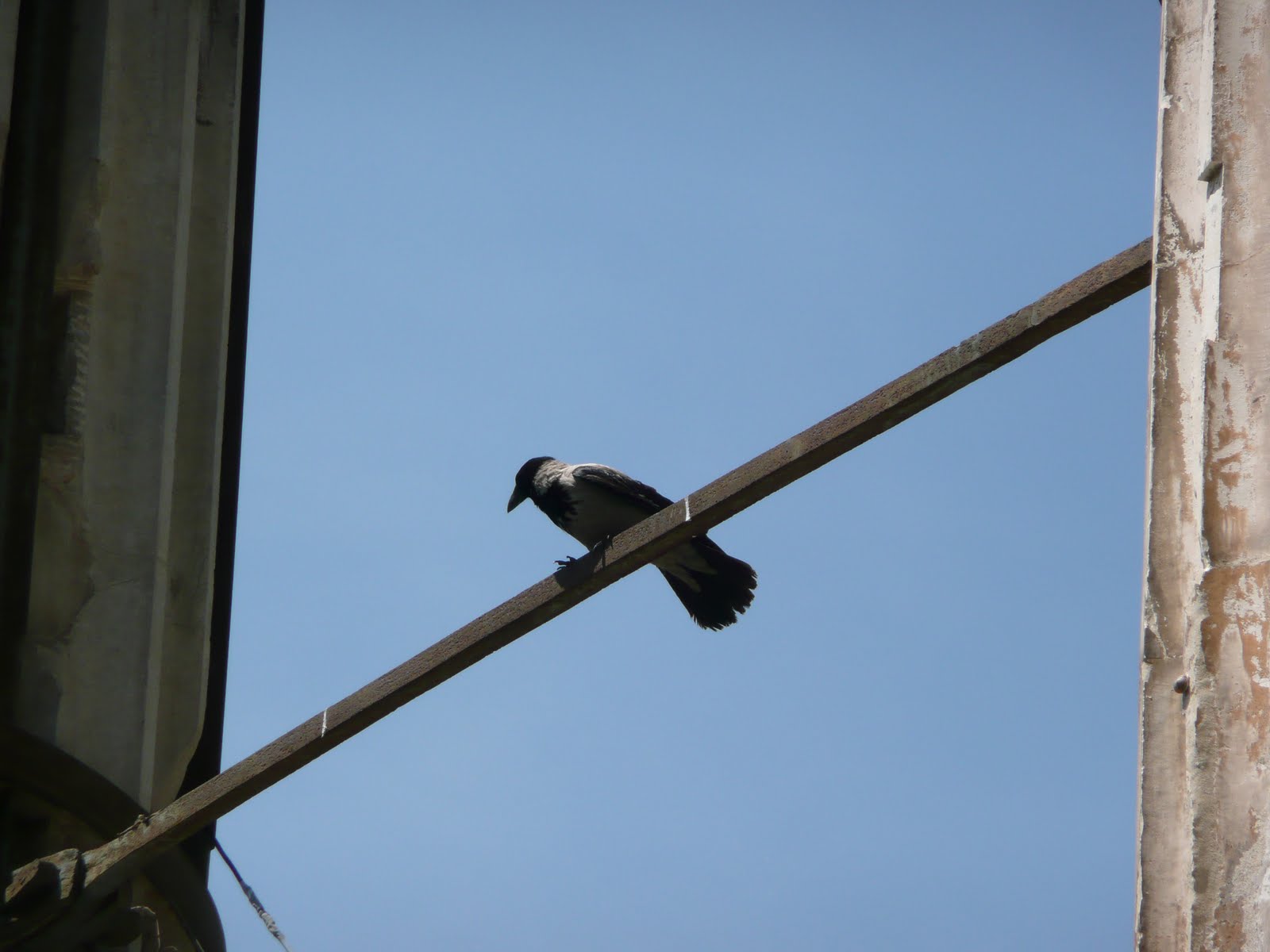 |
| Hooded crow (Corvus cornix). Forum of Augustus, Rome |
There were lots of starlings and other common 'garden' birds hanging around too, which I didn't manage to photograph. I also saw some bats flitting around by the Colosseum, but didn't spot the kestrels that the sign in the park suggested I should see in Rome. To be honest, I was dubious anyway - the kestrel isn't something I'd usually think of as an urban bird.
And even though the birds I did photograph are all common as muck, they still provided a learning opportunity...for example, I had only ever seen one hooded crow (while in Scotland), and didn't know they were so common in Europe; they were everywhere both in the city and out at Ostia. Also, I hadn't realised that the sparrows in Italy were their own species. I had naively assumed that they were the same as the sparrows we find in Britain - they certainly look very much like tree sparrows at a casual glance (and my photo isn't exactly much help in identifying it, because it's taken from too far away!).
Obviously I didn't only take pictures of common wildlife. I do also have lots of photos of stunning Roman architecture and statuary, but since they're not biological in nature I'm not putting them up here...Oh, go on then, you've twisted my arm. You can have one.
 |
| Statue of Hercules. Temple of Hercules, Ostia. |
What did I tell you? Stunning statuary.
Monday, 16 May 2011
Biodiversity Rocks!
...as the sticker I was given at Bristol Zoo on Saturday says!
It is currently Biodiversity Week at Bristol Zoo, and I was there with the Bristol Museum posse to show people some native insects from our collections, while the biology curator led bug-hunting trips around the herbaceous border. The rain held off, which was good for insect-finding, and we saw lots of bees, flies, and a male common blue damselfly. I felt a little inadequate at times, as people asked me to try and ID insects they'd seen in their gardens from vague descriptions, and I was forced to admit I didn't have a clue (I'm a vertebrate zoologist! I'm pretty hopeless with all things spineless), but thankfully I had two knowledgeable insect people on hand to help out! I, of course, kept getting distracted by birds (that being my latest obsession and all). And not just the ones in cages...Bristol Zoo is swarming with wild native species, and they are all very bold around people - the picnicers on the lawn were constantly being eyed up by jackdaws and robins, who came very close and waited around for morsels to be dropped in their direction. I talked to some people about moths, the kids that the curator took around the border actually caught some insects (which is a minor miracle given how some of them were randomly running round waving their nets!), and a good day was had by all.
I even had some free time to wander round the zoo, which has changed considerably since I was a kid. They've reduced the number of big cat species they keep to expand the lion enclosure to a good size, the monkey and bird houses have been completely renovated, and conditions all round seem to have improved. I was quite impressed. And I got to feed some lorikeets, which was pretty amazing.
Sadly, Saturday's little adventure probably marks the end of my voluntary work with Bristol Museum, as I have been offered a documentation job in London and will be moving soon. Which probably means that the foreign bird mount project will never get finished - they won't curate themselves, you know! But the London job is only temporary until April next year, so I may yet be back! They can't get rid of me that easily :)
Saturday, 23 April 2011
Becoming A Twitcher: Part II
In which I try to get better acquainted with the neighbours, while my cat just tries to kill them...
I have spent some time this week watching the house sparrows that abound here, and have quite enjoyed it. I'm becoming fond of the little guys. On Tuesday morning there was a whole crowd of them in the garden, using our old pile of shrubbery-related waste as a source of nest materials, and having dust-baths in the gravel. I had been planning to get rid of that pile of rubbish, but have now decided to leave it there for a while. The birds seem to have been very busy finishing off their nests in the last few days, dashing back and forth between our hedge and the roof in which they roost. I even managed to get close enough to take some photos of these tiny, but quite pretty, birds:

I have spent some time this week watching the house sparrows that abound here, and have quite enjoyed it. I'm becoming fond of the little guys. On Tuesday morning there was a whole crowd of them in the garden, using our old pile of shrubbery-related waste as a source of nest materials, and having dust-baths in the gravel. I had been planning to get rid of that pile of rubbish, but have now decided to leave it there for a while. The birds seem to have been very busy finishing off their nests in the last few days, dashing back and forth between our hedge and the roof in which they roost. I even managed to get close enough to take some photos of these tiny, but quite pretty, birds:
 |
| Female |
 |
| Male collecting nest materials |
I also discovered this week that we have some more feathered neighbours...I knew there were blackbirds around, because they are quite visible and vocal garden birds, but I didn't know what else was nesting in the Leylandii that line the backs of the gardens on our street - the trees are so dense that you cannot see. Usually. However, thanks to this giant monster (he really is a very large cat!),

who goes by the name of Loki (but has been sweetly nicknamed Lucifer by the people next-door!), I got to see some of them yesterday, when he raided a dunnock nest and killed two chicks (well, we're hoping he'd killed the first before my sister's spaniel pup stole it and ate it! We took the second one off him while it was just about still alive, because we didn't think the pup needed any more snacks! It died shortly afterwards). The parents hung around to protest for a very long time (they were still calling this afternoon), but have hopefully moved on now. I don't know if it is early enough in the season for them to raise a second clutch (and of course they would have to move their nest away from our garden!). Dunnocks are very interesting little birds with very inventive love lives, but their offspring are obviously very boring, because all the internet would tell me about dunnock nests is that they often play host to cuckoo chicks. Which we don't have around here.
I am slowly increasing my abilities in birdsong recognition, and can now add dunnocks to the repertoire, thanks to yesterday's little escapades, as well as house sparrows.
Friday, 15 April 2011
Foreign Bird Mount Project: Week I
So, having figured out how much (or how little, as the case may be) progress had been made on the foreign bird mount collection in the past, this week I was ready to get down to work and start curating some birds.
It was a slow start, as I discovered half a cabinet that had been missed previously and had to back-track a little from the place I thought we'd be starting at, but good progress was made:
One shelf of pigeons was fully documented and photographed, and we made a start on the next shelf, containing parrots, including a beautiful glass case of 5 birds posed on some artfully arranged vegetation with a lovely painted background.
I even managed to identify a couple of birds that had no data on them, by comparison with other specimens (only the obvious ones. For example, there were two birds labelled as crested pigeons (Ocyphaps lophotes), and a third with no label that looked just like them. As there are no other species of crest-bearing pigeon with which it could easily be confused, it was a fair assumption that they were all the same species).
It's a good feeling to be doing some real curatorial work, and to be able to do it - it's a great boost to the confidence to be given a job and then left to get on with it, knowing what I'm doing and not needing supervision! It's not very glamorous, though...many of the specimens are very old and covered in nasty substances (arsenic, mercury, methyl bromide, who knows what else...), so we have to wear lab coats, gloves, and gas masks when handling them. It's not a good look. The masks are really uncomfortable, and a bit hard to breathe in, but I suppose it's better than inhaling lots of arsenic dust!
For the benefit of my non-museum readers (which is probably a good half of my readership of about 10 people!), I suppose I should explain exactly what I'm doing, because museums are rather odd, esoteric worlds to those not in the know!
The procedure for curating/documenting a collection is fairly straightforward (if a little long-winded. Sorry):
The background:
When an object enters the museum (e.g. through a donation/purchase/bequest) it is given an accession or entry number, and a form is filled out with details of what it is, where it was collected and who it came from (if these details are known). Often a group of material will be acquired in one batch, and the objects will all be given the same accession/entry number.
Each item is then given an individual and unique register number, and the details of the specimen will be recorded in a register book (or on a computer database - some museums no longer use paper records much). There are recognised standards for the documentation of museum material, and the most basic standard requires that records include: what a specimen is, where it's stored within the museum, and that both the record and the specimen bear the register number (so that you can find it again, obviously!).
However, over time information about specimens may be lost (Bristol Museum, for example, lost both a lot of information and a lot of specimens in WW2 when the museum was bombed), or the specimens may become disassociated from any information about them, or accessioned material may never get as far as being registered. Many museum collections include material that is variously: fully accessioned and registered; accessioned but not registered; either of the above but the information has been lost/disassociated; lacking any data at all.
So that the museum knows what it has and where everything is, it is important that each specimen has some documentation. This is where I come in:
So, that's what I do! Exciting, isn't it? Hello? Anyone there...? Oh, you've fallen asleep. Never mind, then. I'll let myself out quietly...
It was a slow start, as I discovered half a cabinet that had been missed previously and had to back-track a little from the place I thought we'd be starting at, but good progress was made:
One shelf of pigeons was fully documented and photographed, and we made a start on the next shelf, containing parrots, including a beautiful glass case of 5 birds posed on some artfully arranged vegetation with a lovely painted background.
I even managed to identify a couple of birds that had no data on them, by comparison with other specimens (only the obvious ones. For example, there were two birds labelled as crested pigeons (Ocyphaps lophotes), and a third with no label that looked just like them. As there are no other species of crest-bearing pigeon with which it could easily be confused, it was a fair assumption that they were all the same species).
It's a good feeling to be doing some real curatorial work, and to be able to do it - it's a great boost to the confidence to be given a job and then left to get on with it, knowing what I'm doing and not needing supervision! It's not very glamorous, though...many of the specimens are very old and covered in nasty substances (arsenic, mercury, methyl bromide, who knows what else...), so we have to wear lab coats, gloves, and gas masks when handling them. It's not a good look. The masks are really uncomfortable, and a bit hard to breathe in, but I suppose it's better than inhaling lots of arsenic dust!
For the benefit of my non-museum readers (which is probably a good half of my readership of about 10 people!), I suppose I should explain exactly what I'm doing, because museums are rather odd, esoteric worlds to those not in the know!
The procedure for curating/documenting a collection is fairly straightforward (if a little long-winded. Sorry):
The background:
When an object enters the museum (e.g. through a donation/purchase/bequest) it is given an accession or entry number, and a form is filled out with details of what it is, where it was collected and who it came from (if these details are known). Often a group of material will be acquired in one batch, and the objects will all be given the same accession/entry number.
Each item is then given an individual and unique register number, and the details of the specimen will be recorded in a register book (or on a computer database - some museums no longer use paper records much). There are recognised standards for the documentation of museum material, and the most basic standard requires that records include: what a specimen is, where it's stored within the museum, and that both the record and the specimen bear the register number (so that you can find it again, obviously!).
However, over time information about specimens may be lost (Bristol Museum, for example, lost both a lot of information and a lot of specimens in WW2 when the museum was bombed), or the specimens may become disassociated from any information about them, or accessioned material may never get as far as being registered. Many museum collections include material that is variously: fully accessioned and registered; accessioned but not registered; either of the above but the information has been lost/disassociated; lacking any data at all.
So that the museum knows what it has and where everything is, it is important that each specimen has some documentation. This is where I come in:
- Each shelf of foreign bird mounts is decanted, and the birds are sorted into those that already have register numbers attached to them, and those that don't.
- For the ones that have register numbers, it is simply a case of checking that their records and labels contain all the same information, and that the information is correct.
- The ones that don't have register numbers are given shiny new register numbers and all of the information available on each specimen's label (if there is any) is entered into the register book. If they have no information, they are still given a register number but just have to go into the book as, e.g., 'unidentified parrot'. A label is attached to any specimens that don't already have one.
- Every specimen is then photographed (making sure the register number is visible in the photo so we can match photos to the correct specimens later), and checked for any evidence of pest damage.
- The shelf the birds came from is cleaned, and the birds returned to the shelf, in taxonomic order where space allows (with the prettiest ones to the front to impress visitors to the store!).
- All of the records, and the photographs, will eventually be transferred onto the computer database, where they will be searchable via the internet.
- Once the whole collection is documented, they will then be sorted properly into taxonomic order (they are currently roughly in order, but somewhat mixed). This is important because it makes specimens easier to find when they are in a recognised order. There are other systems for ordering collections used in museums (including alphabetical), but taxonomy is a more useful system because it puts related species near each other and more findable if, for example, someone requires members of a particular order or family for research.
So, that's what I do! Exciting, isn't it? Hello? Anyone there...? Oh, you've fallen asleep. Never mind, then. I'll let myself out quietly...
Subscribe to:
Posts (Atom)